


Towards more sustainable urban developments
Modern cities are facing increasing challenges linked to urbanization: soil sealing, stormwater management, urban heat islands, and soil degradation. Earthworks and urban development projects, essential for infrastructure expansion, often contribute to these issues.
Urban soils are typically compacted, low in organic matter, and poorly permeable, limiting their ability to absorb water, increasing runoff, and making it more difficult to establish sustainable developments.
Long considered a difficult constraint to overcome, these challenges now require innovative solutions. Fully committed to environmental performance, the SOLER Group develops sustainable alternatives to improve urban soil quality and support the transition toward more resilient cities.
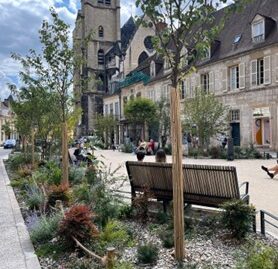
The transformation of the Place Bossuet in Dijon employed Soler biochar as part of the growth substrate for planting.
Improving stormwater management in urban environments
Stormwater management has become a major challenge in urban development projects. Surface sealing and earthworks increase runoff, leading to overloaded drainage systems and a higher risk of flooding.
Thanks to its porous structure, the biochar developed by the SOLER Group helps to:
- Promote water infiltration into the soil
- Slow down water flows
- Temporarily store water and release it gradually
When integrated into soils or engineered substrates, it improves the efficiency of systems such as swales, tree pits, and drainage trenches, while contributing to more sustainable stormwater management.
Soils resulting from earthworks are often degraded, compacted, and low-functioning. This poor quality limits their ability to support sustainable developments, particularly vegetated ones. The use of biochar helps restore the physical properties of soils:
- Improved porosity and aeration
- Reduced compaction
- Enhanced structural stability
- Promoted root development
These characteristics make it particularly well suited for public spaces, green streets, and landscaped urban areas.
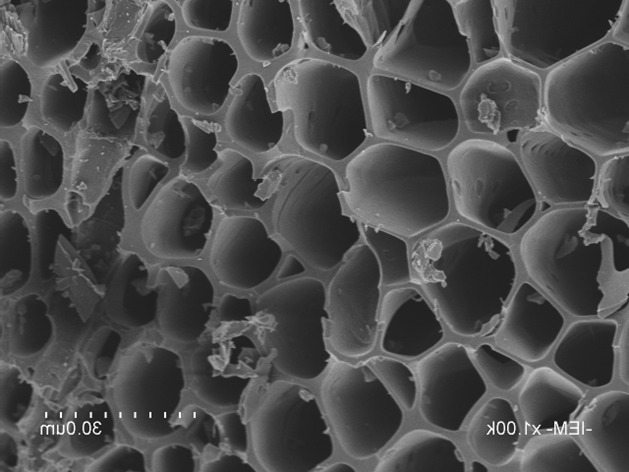
The high internal porosity of biochar is the key aspect which allows for the effective capture of pollutants that would otherwise runoff and potentially overwhelm waters treatment systems.
Reducing pollution and protecting the environment
Urban soils are exposed to a wide range of pollutants from traffic, construction materials, and human activities.
Thanks to its high adsorption capacity, biochar acts as a natural filter, helping to:
- Capture heavy metals (zinc, copper, lead)
- Retain hydrocarbons
- Limit the mobility of contaminants
This contributes to protecting soils, water systems, and urban ecosystems, while meeting increasing environmental requirements.
A lever for more resilient cities
In the face of climate challenges and the need to adapt urban environments, improving soil quality and water management is essential.
SOLER’s biochar is part of this transition, offering a solution that helps to:
- Optimize urban soils
- Improve stormwater management
- Reduce the environmental impact of developments
It contributes to building more sustainable, efficient, and climate-resilient urban spaces.
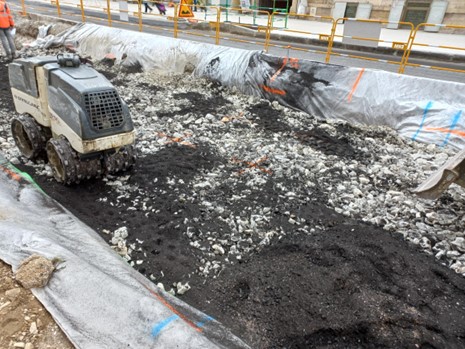
In Dijon and in other locations, the Stockholm method was followed, where pits or trenches are dug which will eventually retain water. They are then filled with the appropriate biochar/compost/aggregate mixture and then planted.